








Author: Sam Fried
Sam Fried spent 40 years chasing birds before he started chasing golf courses. A reformed trial lawyer, he started his own birdwatching touring company that offered the only combined birding and golfing trips in the world. He invented the birding/golfing handicapping system, wherein the winner combined his golf score, handicap and the number of bird species identified during a round. Despite this idea never catching on, Fried continues to track the number of bird species he's seen and photographed and the golf courses he has played - 637 as of this writing. His favorite quote: "Get obsessed and stay obsessed", Coach Bob, in The Hotel New Hampshire, by John Irving.
A Tale of Two Nines Ready for a Revamp
As any golfer passionate about the sport will tell you, not much could be worse than having no place to play. But it would be far worse if you were surrounded by golf courses and not permitted access to any of them. Such was the situation for every Black golfer in our nation’s capital, Washington, D.C., where one-third of the population is Black and most of the country in the 1920s and 1930s.
The Universal Appeal of Golf
Playing golf has such universal appeal that it cuts across every racial, religious, cultural or other demographic IN THE WORLD. Golfers are probably the most driven participants in any sport who will pounce on an opportunity to smack a little ball across perfectly manicured greens or burnt out rocky fairways and through any weather conditions. It is a universal urge brought out by the uniqueness and allure of the game.
The Golden Age of Golf and the Struggle of Black Golfers
During the “Golden Age” of golf in the 1920s, courses were being constructed all over the USA as demand increased geometrically. By the mid-1930s, there about 5200 courses in the United States, yet only 20 permitted Blacks to play. Blacks were just as enamored of the game as whites, but had virtually nowhere to properly take a stroke. In the 1920s, after years of struggle, a small and wholly inadequate course for Blacks to play was built near the Lincoln Memorial, but within a few years, the course was destroyed to make way for other developments, leaving a gaping hole for Black golfers, because D.C.’s other public courses were officially “whites only”.
The Fight of the Black Golfers
By the mid-1930s, despite having no place to play, Black golfers in D.C., organized both a men’s organization, The Royal Golf Club, and a similar women’s group, The Wake Robin Golf Club. In 1937, they took the fight for a new public course that was accessible to Blacks to the Department of the Interior, where Harold Ickes was Secretary and its National Park Service, which controlled all public land in the nation’s capital. Eleanor Roosevelt reportedly became involved as an advocate for a new course and brought the matter to her husband’s attention.
Secretary Ickes, well ahead of the racism that existed in the country, approved the project and in 1939, under the aegis of the National Park Service, opened a 9-hole course along the banks of the Anacostia River in D.C. and named it for John Mercer Langston (1829-1897), first dean of Howard University Law School and first Black to represent Virginia in the US House of Representatives.
The course was extremely popular in the Black AND white communities of Washington and became one of the first sports institutions in the country that was completely desegregated. Proud of their success with Langston and seeking to expand the playing possibilities for Black golfers, in 1941 members of the Royal Golf Club attempted to play at East Potomac Golf Course, the capital’s other public course. Until then, the course was open to whites only. The police were called and Ickes was asked to intervene. He said, “I can see no reason why Negroes should not be permitted to play on the golf course. They are taxpayers, they are citizens and they have a right to play golf on public courses on the same basis as whites”. Ickes further issued an Order the next day to desegregate all public courses in the city. In 1955, a second nine was added to Langston, designed by William and David Gordon, to bring the course to a full 18-hole par 72 layout, as it exists today.
A Rich History of Golf Legends
Since opening day in 1939, the course has attracted the best Black golfers in the country and regularly hosted tour events on the Black professional circuit. The “Caucasian Only” clause of the PGA, until it was repealed in 1961, kept many outstanding Black golfers from competing in PGA events. Lee Elder, the first Black golfer to play in the Masters, was Langston’s manager and teaching pro in the later part of his career. Charlie Sifford, Calvin Peete and Jim Thorpe, among many other Black golfers who eventually were able to play in PGA events, all spent time at Langston. Numerous Black sports figures and entertainers, like Joe Louis, Billy Eckstine, Ella Fitzgerald, Dionne Warwick, and Bill Russell, all came to Langston for a round.
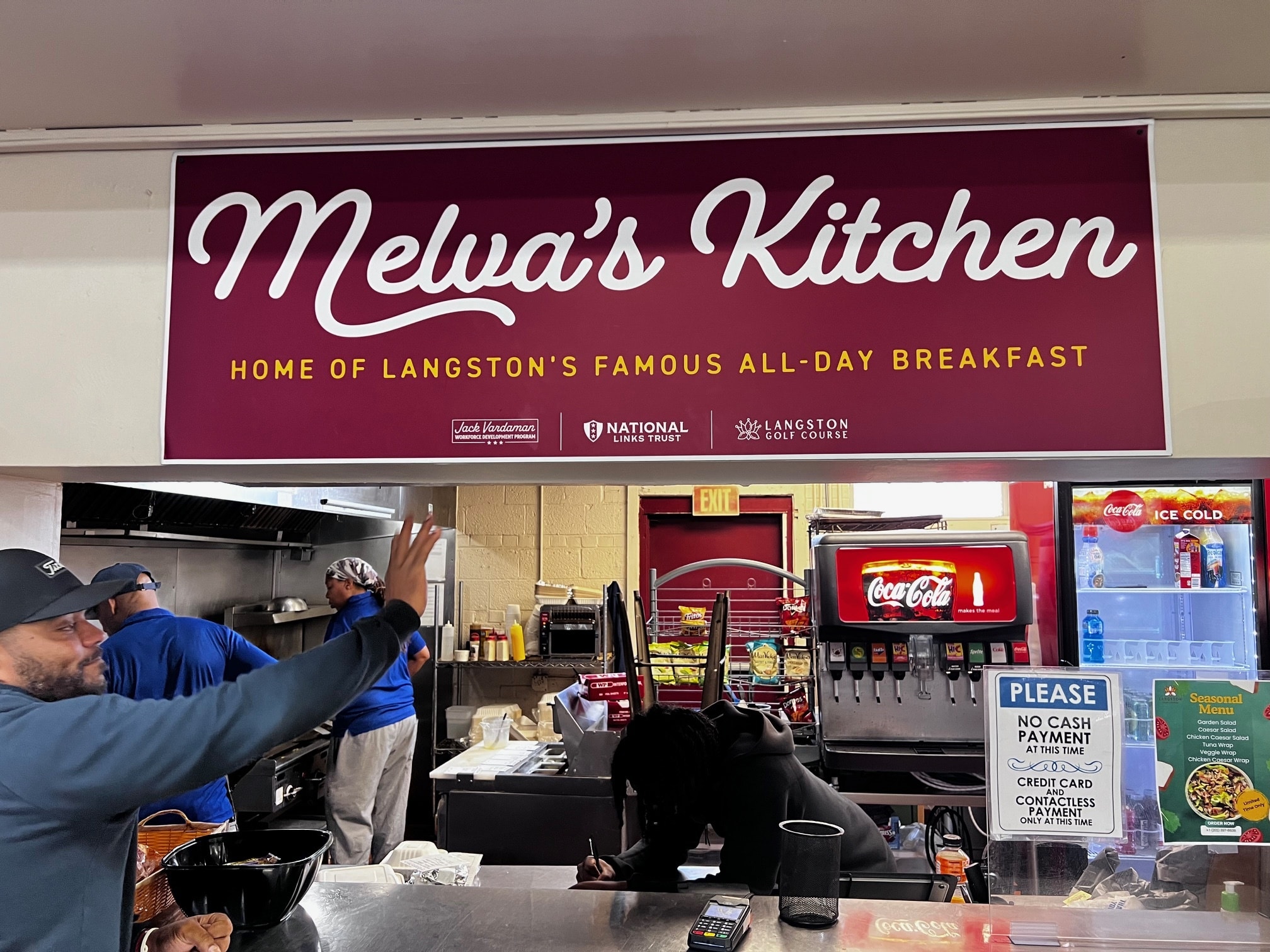
As did I. Having played at least one round in all 50 states, I had never golfed in D.C., so Langston, with all its history and tradition, was the obvious choice. My wife and I got there early, so we could experience the highly recommended breakfasts of Melva’s Kitchen in the clubhouse. We couldn’t have been welcomed more warmly by Ben Foster, the Manager on Duty, who exuberantly expounded on the history of the course. The clubhouse serves as a community center for anyone who wants to come in for a round, a meal or a game of cards with his buddies, or all three. There were lots of kids around, youngsters participating in Langston’s excellent First Tee program and teenagers learning how to play and caddie. Langston also runs a Summer Youth Program and teaches kids how to get into the golf business. Because this was the first day of the epic government shutdown that began on October 2, 2025, the tee sheet was filled with out-of-work federal employees, including our playing partners, Carl Ashley and Matt Wasniewski. Carl is the Historian for the U.S. Department of State and Matt is the Historian for the House of Representatives. These guys knew everything about everything that had ever happened in the USA, including Langston history, making it a fun and informative round.
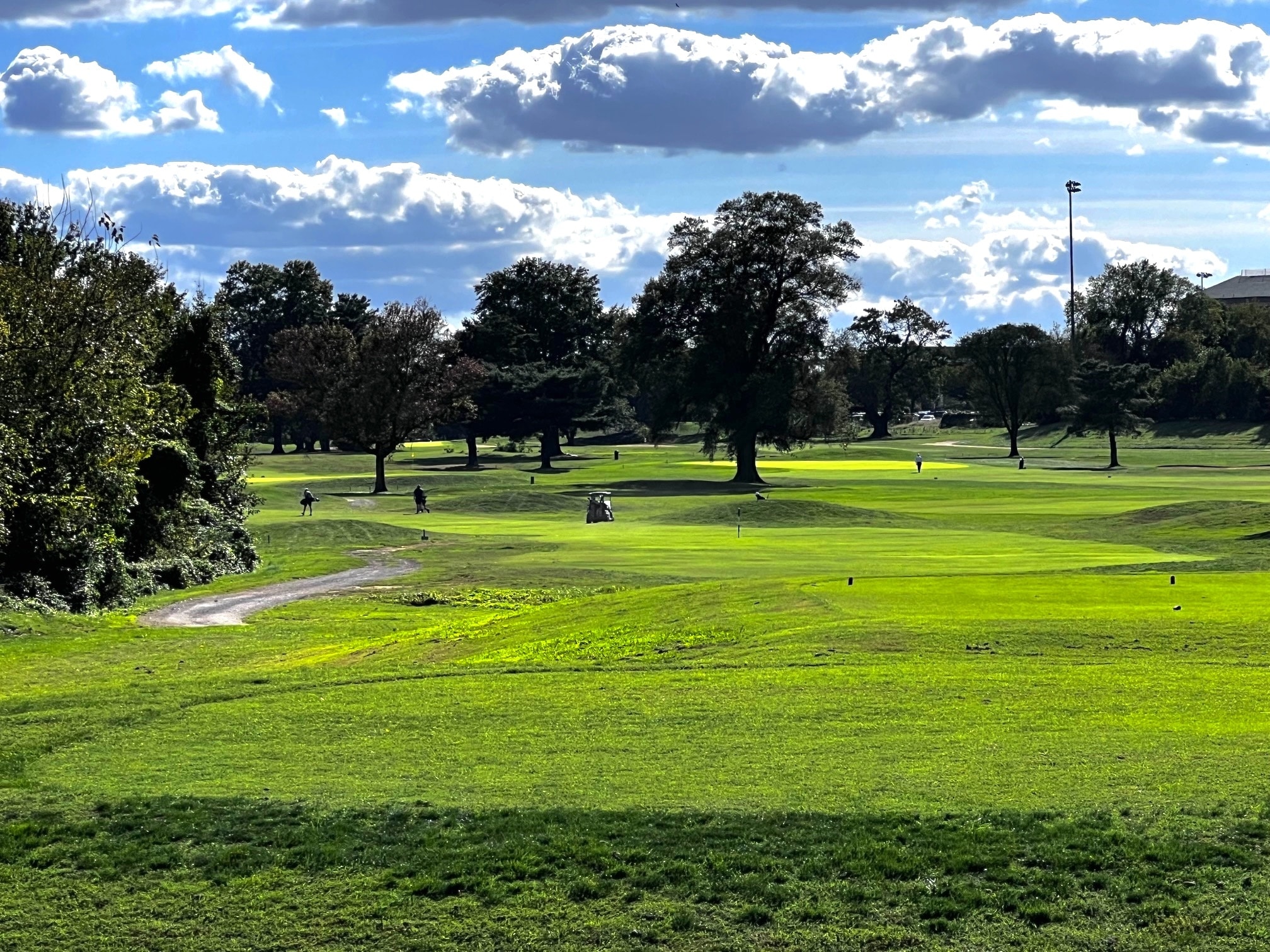
The course itself, now managed by The National Links Trust, and on The National Register of Historic Places since 1991, is a well designed track, but badly in need of funds to improve virtually everything, especially carts and cart paths. The original front nine is vastly different from the more country-like setting of the back, but both present all the challenge any golfer needs for an interesting and fun round. Randall Thompson, the General Manager and Tim Krebs, PGA pro, do all they can to make a round at Langston the best experience it can be for everyone who shows up ready to play.