






Author: Sam Fried
Sam Fried spent 40 years chasing birds before he started chasing golf courses. A reformed trial lawyer, he started his own birdwatching touring company that offered the only combined birding and golfing trips in the world. He invented the birding/golfing handicapping system, wherein the winner combined his golf score, handicap and the number of bird species identified during a round. Despite this idea never catching on, Fried continues to track the number of bird species he's seen and photographed and the golf courses he has played - 637 as of this writing. His favorite quote: "Get obsessed and stay obsessed", Coach Bob, in The Hotel New Hampshire, by John Irving.
“THE DRIVER MAY BE THE RACE CAR, BUT THE SHAFT IS THE ENGINE”
by Sam Fried
As soon as my friend and shaft wizard, Steven Hahn, spoke those illuminating words to me, I was determined to find the right shaft and driver for my swing. Since this is a tale of unrequited love, on Valentine’s Day I appropriately visited the Fujikura Golf shaft company headquarters in Vista, CA. As in all cases of love, pain often lurks in the wings. After spending two hours pounding balls into a screen under the intense scrutiny of fitting specialist Marshall Thompson, I emerged beaten but unbowed. What’s a few blisters when you’re chasing your dream? Assisted by an array of monitors, cameras, lights and other devices, he analyzed every part of my swing, the club, shaft and ball I was using and whether my shoes were tied too tightly.
We began with a little talk about the kind of game I have, what I was looking for in a driver, if I have any serious health issues that would affect my swing, any serious psychological flaws that could appear during torture. I warmed up with a few swings of a 6-iron, feeling a mixture of confidence and terror about what was to come. My precious golf swing, cultivated over decades with all its glorious flaws, was about to be scrutinized under the harsh light of reality. Then the moment of truth arrives – Marshall hands me my own driver, with a standard factory shaft, regular flex and 9.5˚ loft, referred to as the “gamer”, and asks me to hit some balls as a baseline for comparison with other equipment. He asked what balls I prefer, since they have drawers full of all the major brands and models.
Fujikura is not affiliated with any of the original equipment makers (OEMs), like Ping, Callaway, TaylorMade, PXG, etc., but has arrangements with them to have a broad sampling of all their driver heads and other hybrids and irons. All club heads can be quickly attached to any Fujikura shaft so that they can put one of their shafts on any major club on the market.
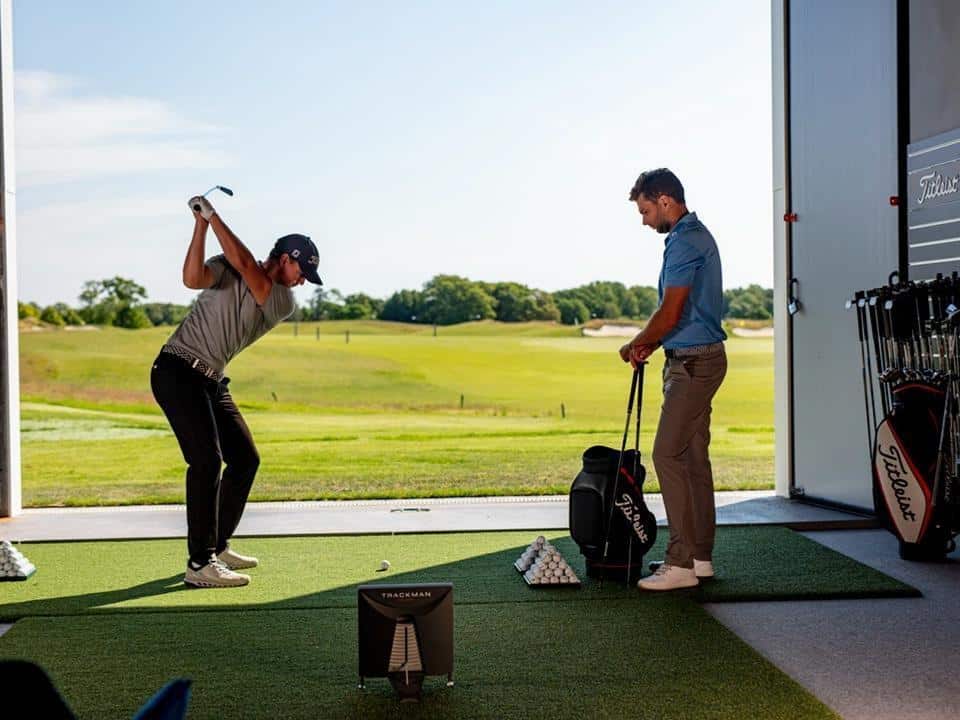
The fitting studio, extremely impressive with all its highly technical equipment and tools, has launch monitors front and rear and a bank of digital cameras that record every aspect of the swing. From an artificial grass mat “fittees” hit balls into a large screen where a wide fairway is projected, a center stripe painted down the middle like I-95. So far, nothing unusual. Then the fireworks start.
With my “gamer”, I bang out half a dozen shots, each one creating a brightly colored tracer showing its arc, deviation from the center line, where it lands, bouncing to a virtual stop. I’m getting into this. It’s actually more relaxing and certainly more interesting than teeing off on number one in my Friday league. You can take all the mulligans you want. After spraying a few and a couple that I felt were fairly good, Marshall flips the screen from “fairway” to reveal all the data that he has acquired from my efforts. An amazing array of numbers stared back at me: club head speed, ball speed, launch angle, azimuth (what the hell is that?), side spin, back spin, total spin, descent angle, carry, total distance, offline and peak height. At the moment, I can’t even begin to digest what it all means, except total distance and “offline” – how far away the ball finished from the center stripe. Marshall explained I’ve got too high a launch angle, too much side spin and back spin and total spin and because of all that spin, the ball doesn’t roll out very far after landing, especially when I slice it like a loaf of bread.
Now we start trying different combinations of driver heads and Fujikura shafts.
Far from being a subjective comparison, the array of data reveals what I’m doing and what’s best for me, assuming I’m putting good swings on the ball. When I hit a clunker, Marshall dumps the data, just like posting an unusually high score for your handicap. We run through the various shafts Fujikura makes, shifting them from heads by from the top manufacturers, all with different loft angles and their own individual sounds and feel. My shot pattern starts to tighten after about an hour of smacking balls as Marshall begins to home in on what might be best for my particular method of thrashing. Despite my obviously imperfect stroke, Marshall is not trying to change my swing – he is searching for a driver shaft combination that is best for my swing, whatever it is. That’s the magic of club fitting. A Master Club Fitter’s ultimate goal is to find the perfect club to help YOU get the most out of YOUR swing.
Another hour. My hands hurt. My arms are getting weak. My legs are quivering like wet spaghetti. There are multi-colored tracers all over the screen tracked to every shaft/driver combination we have tried. It looks like neon Silly String at a New Year’s Eve party. But have we reached Nirvana? Marshall, now my lord and master, is ready to make his proclamation. My stats with a Ping driver, driven by the Fujikura shaft, 45.25” stiff flex, are far superior to any other combination I used. Two MPH more clubhead speed, three more MPH ball speed, better launch angle, far less spin, five yards less side dispersion for straighter shots, longer carry and longer roll-out for 16 more yards total distance! Marshall explained that his goal was to find the driver for me where I can tee it up and confidently rip it, enabling me to fully go after the ball. I am exhausted, but completely sold on the process. Now I can’t wait to take it out on the course.
Determined to leave no stone unturned and no shot dropped, I visited the PGA Learning and Performance Center in Port St. Lucie, Florida to have my iron shots and putting evaluated.
This extensive facility is one of the premier practice and teaching centers in the world, as evidenced by college golf teams and pros who attend each spring from all corners of the planet to work on their games. It features almost every cultivar of grass a golfer might find on a course, a wide variety of practice bunkers filled with different types of sand, multiple putting, pitching and chipping greens and a huge practice range that presents all angles from elevated tees to greens. If you like to work on your game, this is golf heaven, and right next door is PGA Village, with three championship courses.
Mark Drenga, PGA pro and club fitting guru, escorted me to the range, towing a special cart loaded with electronic gear and an assortment of interchangeable shafts and iron heads. Other than being outdoors, so we could see the actual ball flight, and hitting off real grass, the process was very similar to that employed at Fujikura’s indoor studio. There is a major difference between the driver and iron fitting, however. With the big dog, you want to get it barking as long and straight as possible. There is only one function for irons – accuracy with distance control. As long as you are consistent, it really doesn’t matter how far you hit each club. I warmed up with my “gamer” 7-iron, then Mark put me on the launch monitor to see the data of my strike and ball flight. He set up a rectangular black plastic “strike plate” for me to hit from, to reveal whether I had the correct lie angle for my iron at the point of impact. We experimented with a number of combinations, including steel and graphite shafts, measuring the data and “feel” of each club. To keep me honest, he secretly set up one club that he knew was completely wrong for me and asked how it felt. I hated the club and had a hard time making any kind of decent ball contact. Mark said, “Unfortunately, that’s what can happen buying clubs off the rack. The clubs may be very good, but if they don’t fit your swing, they’ll keep you from enjoying the game. That’s why it’s worth it for anyone, regardless of their skill level, to be fitted by a professional”.
My final part of the fitting process was to have my putting stroke analyzed by the “SAM” putting laboratory, by Science And Motion Sports.
This $10,000 device measures everything about a putting stroke: face, aim, direction, path forward and back, point of impact on the putter face, loft and rise of the putter, launch and spin, and putter face rotation during the stroke. It also measures backswing, forward swing, timing and speed at impact. All this from stroking only five balls. If I ever thought about any of this during my stroke, I could never pull the club back! We discovered several important things about my putting: a) it was way off; b) my putter, at 35”, was too long for me. Mark told me that the average putter length on tour is 32.5”, so I needed to cut it down an inch and choke up as usual; c) my putter, marked as having 4 degrees of loft, actually had 5 degrees, probably the result of getting banged around for many years. This is fine for Florida Bermuda grass greens, where the ball sits down a bit, but for northern bent grass greens, 3 degrees of loft is preferable, to get the ball rolling sooner; d) the grip on my putter was worn out and was off 2 degrees; e) my putter was not properly “face-balanced” for my arcing stroke. PGA Master club technician Jerry Lovell fixed everything by crafting lead tape to the putter head, giving it a more balanced feel, cutting an inch off the shaft and installing a new grip. Other than that, nothing was wrong.
The end result of all of this?
I fully expected that the next time I teed it up I would be striping it 275 down the middle of the fairway every time, puring irons onto each green and draining every putt. What really happened? Unfortunately, golf and miracles are two mutually exclusive worlds, but my drives, when I make a good swing, fly further and roll out longer than ever before. On average, I gained at least 15 yards! I have more confidence that my irons and hybrids are the right clubs for me and the putter feels better in my hands, giving me more confidence in my stroke and generally better results. It still comes back to 90% of this game being between your ears, but knowing I have the right tools in my hands makes the whole process that much easier. The cost of all this – about what you’d pay for a new driver off the rack. The benefits far outweigh that new driver. Except that now you may be going out and buying all new clubs, ones that actually fit your swing. Even if you have been fitted in the past, we all realize, albeit reluctantly, that our bodies change as we age, and just like getting your tires rotated and rebalanced, the same should be done for your clubs to maximize their performance.