







“If you build it, he will come”. Field of Dreams (1989).
When those words were whispered into Ray Kinsella’s ear, encouraging him to build a baseball field amidst the cornstalks of Iowa, Dick Youngscap must have been listening when he opened ultra remote Sand Hills Golf Club in Nebraska in 1995. He enlisted Ben Crenshaw and Bill Coore to rewrite where and what a great golf course could be on perfect dunesland for an inland links. Mike Keiser heard that same siren song when he built Bandon Dunes in nowhere, Oregon, creating a model for a world-class multi-course site open to the public. Since 1999, when Bandon opened to great fanfare and success, other golf developers have learned that with perfect links land for a multiple course resort, no matter how remote, golfers will come to play. The same avenue was followed by Streamsong in Florida, Prairie Dunes and Dismal River in Nebraska, Sand Valley in Wisconsin and now Gamble Sands Resort in Washington State.
About the Construction of Gamble Sands Resort
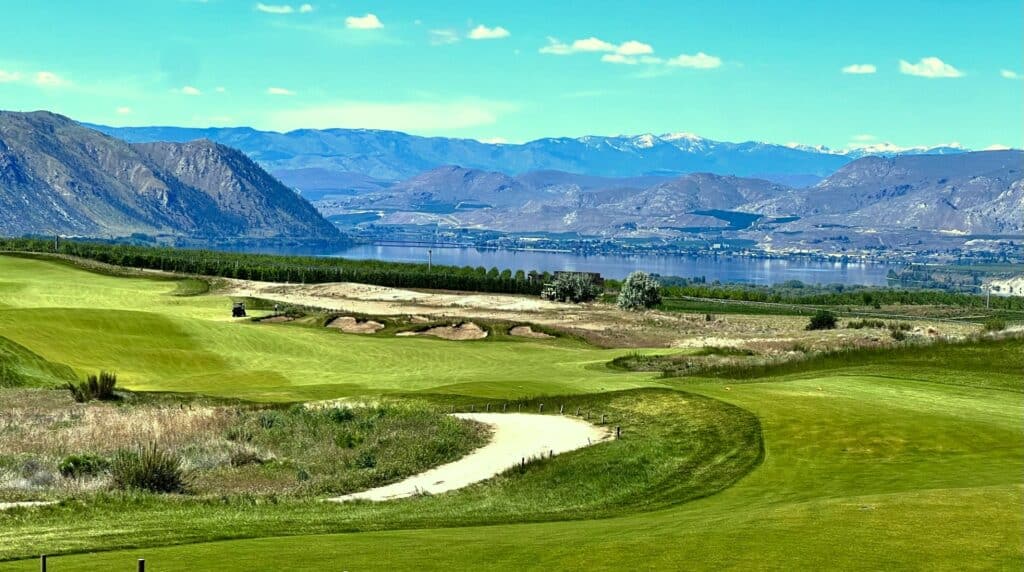
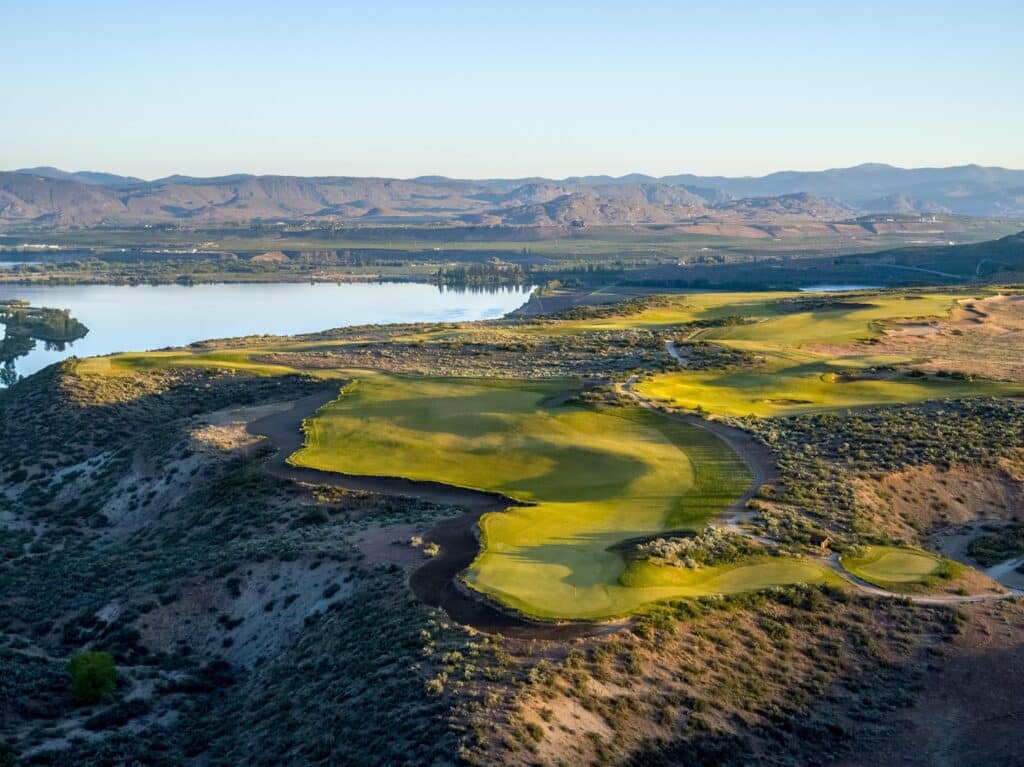
Keiser presciently hired young Scotsman David McLay Kidd to design and build the eponymous first course at Bandon. Kidd so fell in love with the Pacific Northwest that he moved his family to Bend, in central Oregon. Not far away, in north central Washington State the Gebber family, the largest ranchers and fruit producers in Washington, hired Kidd to create another masterpiece on their farmland high on the treeless bluffs overlooking the Colombia River Valley. Named the “Best New Course” in America by Golf Digest, Gamble Sands opened in 2014 and began attracting golfers from every corner of the globe. In 2021, Quicksands, a 14-hole short course and Cascades, a huge putting green, were added. In 2025 the Gebbers took the resort to the next level by opening a second contiguous course, Scarecrow, designed by Kidd and his partner, Nick Schaan, which also received “Best New Course” accolades.
The Gameplay at Gamble Sands Resort
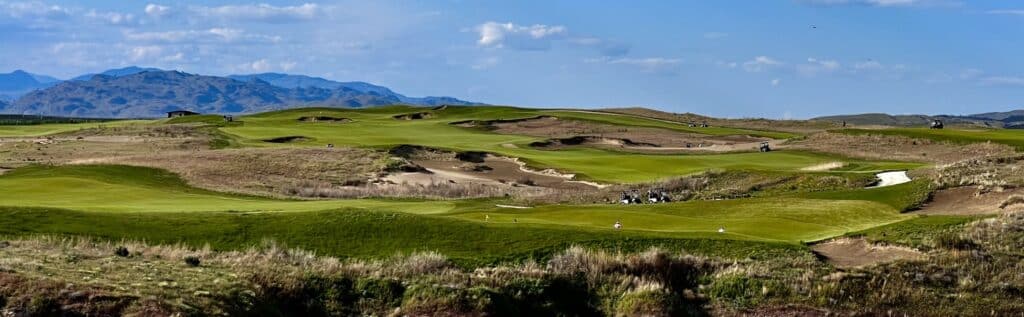
David McLay Kidd convinced the owners that he would “Let the course float down and lay upon the land.” Instead of making the course difficult, Kidd’s philosophy was “make the course playable and fun for golfers of any skill level.” As a result, Sands features massive fairways and greens where it’s hard to lose a ball. Golfers can putt from almost anywhere off the green as the fairways are almost as fast as the putting surfaces.
The Sands course opens your eyes as soon as you step onto the first tee. If you haven’t played true links golf before, both the Sands and Scarecrow courses are as close to Scotland and Ireland links as you can hope for absent an ocean, with the added pleasure of generally nice weather. Pure fescue grasses are used on tees, fairways, greens and roughs, grown on top of ancient sand dunes created by massive ice age floods that deposited vast amounts of sediment. Fairways and greens are hard and fast, taking your shots on roller coaster rides once they hit the ground. Before golf courses were built here, this type of quick draining but rich soil was well known to be perfect for growing cherries, apples and grapes, the economic soul of the region.
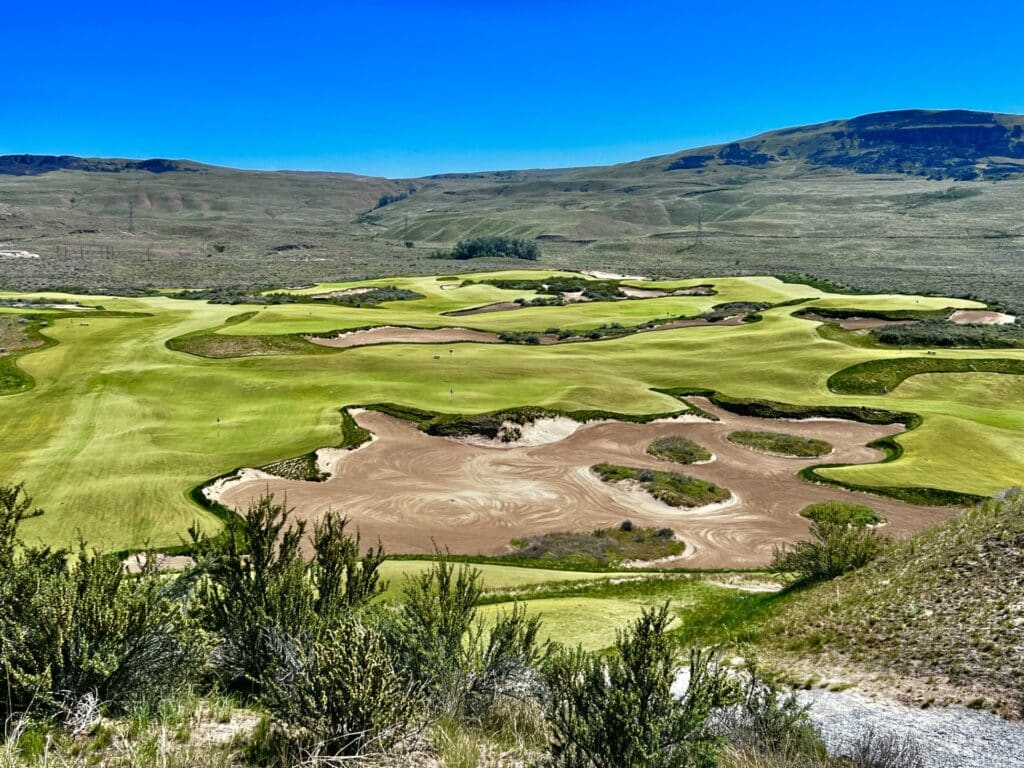
If the Sands course is for bombers, Scarecrow is for for tactical fighter jets. With narrower fairways and smaller more contoured greens, Scarecrow plays along razor-edge ridge lines, around and through canyons, over blind hills, and has severe elevation changes. Often offering several approach routes to a sometimes hidden green, it’s like playing a game of “Chutes and Ladders”. Kidd
said that Scarecrow was six shots harder than Sands, but I found it to be far more fun and actually played easier than the first course. “Power” is the catchword for Sands, while “accuracy” perfectly describes Scarecrow’s requirements, yet both are very “ball findable”, as Kidd says.
The Quicksands Short Course
After, before or in between playing Sands and Scarecrow, every visiting golfer should play the 14-hole par-3 Quicksands short course, designed by Kidd’s partner, Nick Schaan. With greens as convoluted as a storm-tossed sea, the most fun is putting them – there are no straight lines here, but by using backstops and sidehills a short putt can be made into a much longer wonderment of curls and twists, starting with your back to the hole. Give up the notion of scoring and have much more fun!
For more information about the Gamble Sands Resort, go to: www.gamblesands.com
Getting to Gamble Sands Resort
Gamble is a long way from any major city, but the easiest drive (2.5 hours) is from the small and friendly airport (GEG) in Spokane. There are also many fine golf courses in Spokane, among them Kalispel Golf & Country Club, which we thoroughly enjoyed. The alternative is Seattle’s busy Sea-Tac airport (SEA), which is four hours away.
Lodging at Gamble Sands Resort
There aren’t a lot of choices to be found in the Brewster, Washington area. Gamble has 77 beautiful rooms overlooking the courses. We stayed at Lone Point Cellars, about 20 minutes away, a vineyard and boutique hotel which offers exceptional lodging and exquisite fine dining overlooking the Colombia River Valley. Our luxurious cabin offered magnificent views and included a complimentary bottle of one of their appellations, plus a flight of LPC wines at their restaurant, “The Tasting Room”.